
 Admin
Admin Okay, be honest. How many times have you told yourself “kal se early uthunga” and then hit snooze four times the next morning anyway? Same here, for years. I used to think the problem was me — not disciplined enough, not “morning person” material. Turns out the problem was the plan, not the person. Most morning routine advice online is written for people with no job, no in-laws, no traffic, and apparently no need to sleep. That’s not real life for most of us in India.
So here’s a version that’s actually doable. Not a 4 AM wake-up-and-meditate-for-an-hour thing. Just the best morning routine for a healthy lifestyle that fits into an actual Indian household — with power cuts, a nosy neighbour aunty, and a train to catch.
Why bother fixing your mornings at all

Here’s the thing nobody tells you: the first hour after you wake up basically decides how the rest of your day feels. Not in a woo-woo way — in a very physical, hormonal way. Cortisol, blood sugar, mood, all of it gets set in motion early.
If your morning is “wake up late, grab phone, panic-scroll news, skip breakfast, run out the door” — your whole day starts in fight-or-flight mode. You’re reacting instead of living. I’ve done this for years and I can tell you, it’s exhausting in a way you don’t notice until you fix it.
A decent best morning routine for a healthy lifestyle flips that. You’re not chasing the day anymore, the day is following your lead, at least for an hour. And with lifestyle diseases like diabetes and BP issues climbing across Indian cities (ask literally any doctor, they’ll confirm this), mornings are honestly one of the easiest places to intervene.
There’s also a quieter reason this matters. In most Indian homes, mornings are the one window that’s genuinely yours — before the kids wake up, before office calls start, before the household needs something. Once that window is gone, it’s gone for the day. So it’s worth protecting, even a little.
It actually starts the night before
Nobody wants to hear this, but there’s no fixing your morning without fixing your previous night first. If you’re sleeping at 1 AM scrolling reels, no routine on earth makes 6:30 AM feel good. Your body doesn’t care how motivated you are — it runs on hours slept, not willpower.
A few things that genuinely help without turning your evening into a whole production:
- Keep dinner at least 2 hours before bed, since a heavy meal right before sleeping messes with digestion and sleep quality
- Dim the lights and keep the phone away 20-30 minutes before bed — even that small gap helps your brain wind down
- Keep your wake-up time fixed in your head before you sleep, so you’re not deciding it groggily at 6 AM
This isn’t a separate routine, think of it as step zero of the best morning routine for a healthy lifestyle. Skip this and everything else becomes ten times harder.
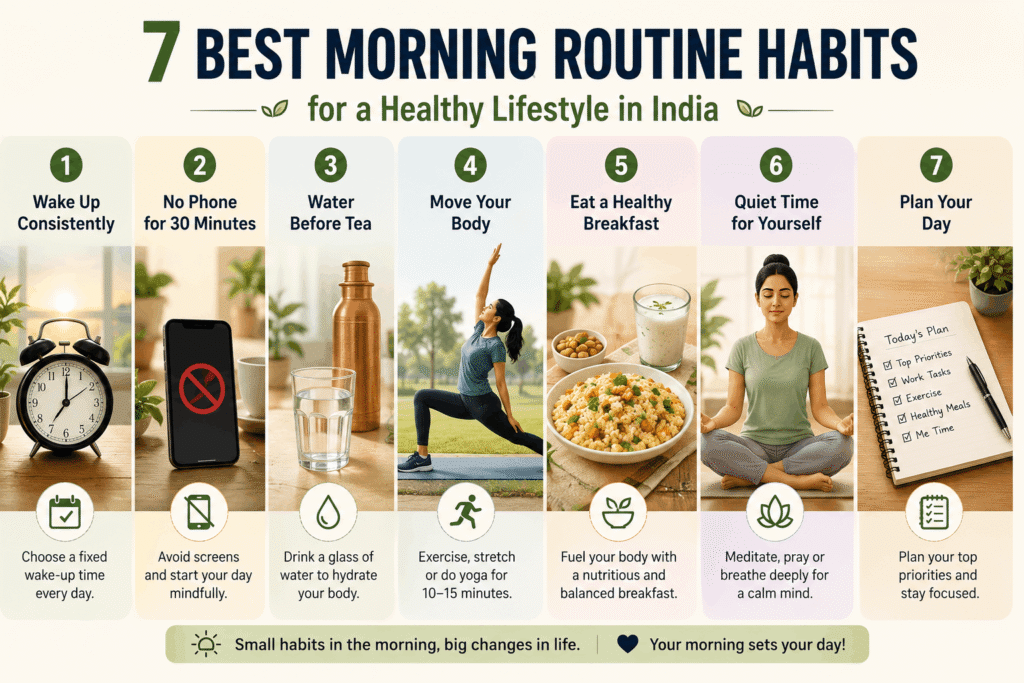
1. Pick a wake-up time you can actually keep — forget 4 AM

There’s this whole “Brahma Muhurta, wake before sunrise or you’re lazy” culture, and look, if that genuinely works for you, great. But for most working people, forcing a 4 AM wake-up on weekdays and then crashing till 11 on Sunday does more harm than good. It’s called social jet lag, and your body genuinely gets confused by it — like flying to a different time zone every weekend.
Pick something boring and doable. 6:30 AM, every single day, weekends included. Consistency beats heroics here.
2. Don’t touch your phone for the first half hour
I know, I know. Your alarm is on your phone. Mine too. But there’s a real difference between turning off the alarm and then opening Instagram at 6:05 AM.
The second you check messages or news first thing, your brain is processing other people’s problems and opinions before it’s even processed its own thoughts. Try this for a week: phone on flight mode till you’ve had water and maybe brushed your teeth. It sounds small. It changes more than you’d expect.
3. Water before chai, not after
Most Indian mornings start with chai. I get it, it’s basically a religion in some households. But your body’s been without water for 7-8 hours overnight, and jumping straight to caffeine on an empty, dehydrated system isn’t ideal.
Just a glass of plain water first. Room temperature, nothing fancy. If you like warm water with lemon, or soaked methi water — fine, that’s a nice old-school habit, but don’t expect it to melt fat overnight like the reels claim. It’s hydration, not magic.
4. Move for even 10-15 minutes

You don’t need a gym membership. Genuinely. What you need is some movement, most days.
Things that actually work for regular Indian schedules:
- A walk around the block or society park before it gets crowded
- 5-10 rounds of Surya Namaskar
- Basic stretches, squats, whatever gets the body moving
- A random 15-minute YouTube yoga video (there are hundreds, pick one you don’t hate)
I switched from “no time for exercise” to just doing 10 minutes of stretching before showering, and honestly my back pain from sitting all day improved more than I expected. This part of the best morning routine for a healthy lifestyle isn’t optional if you sit for work — your spine will thank you later.
5. Actually eat something. Chai-biscuit doesn’t count.
This is a big one. So many of us grew up on “chai and 2 biscuits” as breakfast because we’re rushing for the bus or train. Then by 11 AM we’re irritated, starving, and reaching for whatever’s near the desk.
Doesn’t have to be elaborate:
- Poha with peanuts
- Moong dal chilla
- Boiled eggs or paneer bhurji with toast
- Idli-sambar (go easy on the oil)
- A bowl of sprouts with lemon and chaat masala
The point is — some protein, some fibre, not just refined carbs and sugar. Your 11 AM self will be grateful.
6. A few quiet minutes before the noise starts
This isn’t some imported wellness trend, by the way — a lot of Indian households already do a version of this with morning prayer or a quiet moment before the day begins. You don’t need an app or a cushion. Five minutes of just sitting, breathing, or writing down three things you’re grateful for (or even just three things you need to get done) genuinely lowers stress.
If sitting still feels impossible — and for a lot of people it does — journaling works just as well. Notebook, phone notes app, doesn’t matter.
7. Decide your day before your day decides for you

Ten minutes, that’s it. Before you open your laptop or start the household chores, jot down:
- Your top 2-3 priorities
- Anything on the calendar
- What you’re eating that day (helps avoid the 4 PM “let’s just order something” trap)
People who do this tend to feel less scattered by evening. It’s a small habit that quietly saves a lot of decision fatigue later.
Adjusting this for different kinds of mornings
Not everyone’s 6 AM looks the same, so here’s how this shifts depending on your situation.
If you’re a student: More likely than morning itself, your enemy are the late night scrollies on your phone, the night before your exams. Prioritize Habit 1, 2, and 7, as I’ve mentioned, which means you set one alarm, give yourself at least an hour of not using your phone before you start studying and that you list down today’s tasks quickly in the morning. Please do not try to adopt all of these seven habits. Three or even two really good habits that you incorporate into your daily routine are better than going at all seven habits in a rush..
If you’re a working professional with a long commute: In fact, time is your real limit. Movement and breakfast are likely to be where compromises are made – for instance, walk for 10 mins rather than 20, eat breakfast at your desk rather than your kitchen table. That’s ok too. Some movement is definitely better than no movement.
If you’re a homemaker managing a full household: For those who already get a head-start, cooking and packing school lunches and then rousing sleeping kids. For these morning routines, your precious five minutes of quiet time (habit six) could be your only respite until well past dark. Guard this opportunity.
If you’re a new parent: Forget the sample timeline entirely. Grab whichever piece fits into the chaos — even just the water first thing, or two minutes of quiet breathing while the baby naps. A partial routine done consistently beats a full one you attempt once a week.
Don’t forget the seasons

In India where the weather is unpredictable like no other, a strict routine will often give way to the wind after just a couple of months.
Summer mornings: Those are actually the easiest habits to form: it’s only easy to start your days early once it’s already sunny outside. Just be aware that you’ll need a ton more water than usual.
Monsoon mornings: Throw a wrench in an outdoorsy walking schedule and an on-the-terrace yoga session. Keep an alternative handy – a YouTube stretch vid – so that a rain-soaked week isn’t enough to set back the whole thing.
Winter mornings: Most difficult days for everyone because your bed feels 10x better and it’s dark much later. You do need to keep the time the same, but ease up on yourself with intensity; a slower stretch is still better than none.
What this could actually look like
For someone waking at 6 AM, roughly:
- 6:00 AM – wake up, no phone, glass of water
- 6:10 AM – 15 min stretch or Surya Namaskar
- 6:30 AM – get ready
- 6:50 AM – 5 min journaling or quiet sitting
- 7:00 AM – real breakfast
- 7:30 AM – quick plan for the day, then off you go
Shift this around based on your job, your commute, your family — the order matters less than just having some structure.
Where people usually go wrong
Trying to do all seven at once. No. Choose one, maximum two. Once that works add another.
Copying influencer routines exactly. Just not everyone has 90 minutes in their schedule for a gym-meditation-cold-shower-all-the-things morning. You want realistic best morning routine habits for health you can stick with, not just the idealized Instagram version.
Sleeping at 1 AM and expecting mornings to magically work. There’s no morning ritual to undo a sleep deficit of 5 hours. Take care of your nights.
Abandoning it on weekends. This one undoes more progress than people realise. Weekday-only routines keep your body clock permanently confused.
Treating one missed day as failure. If you missed a day, the twenty days that came before it weren’t undone. Usually when people quit doing something like that, it’s not that the habit itself didn’t work; they used one miserable morning to justify abandoning it altogether.
A few myths worth dropping
So much is made about morning routines, and much of it can actually be quite damaging.
“You need to be disciplined to be able to get up early between 4 or 5AM.” WRONG. It’s consistency that shows discipline. The time itself does not.
“Lemon water burns fat.” It doesn’t, on its own. It’s decent hydration with a pleasant taste, nothing more dramatic than that.
“If you miss one day, you have to start over.” Habits aren’t a video game with a reset button. One missed morning is just one missed morning.
“A real routine needs at least ten habits to count.” Two or three consistent ones outperform ten inconsistent ones, every single time.
How to actually track if it’s working
Most people just quit a new routine when they have absolutely no idea whether it’s working. There isn’t a huge, before/after difference to demonstrate to themselves that it matters so the whole effort starts feeling kinda pointless within two weeks. A few easy things you can do to see some progress:
Keep it stupidly simple . Put a tick in your calendar for each day that you hit one habit. No slick apps or spreadsheets with fancy graphs; a tick that you can literally see. Seeing five consecutive ticks in your calendar has a psychological impact that no notification on your phone ever can.
Check in on energy, not weight or looks. The first visible, tangible sign of this you’ll notice is, in fact, not the mirror but your overall feeling of self during about 4pm. Not the crashing 4pm fatigue, more balanced moods, a general reduced desire to stab someone for a cappuccino. That typically occurs 2-3 weeks prior to a visual change and for a few people, is the telltale indicator it’s “working”.
Give it a proper month, not a week .In the first week, there’s absolutely no sense of payoff; it only feels artificial and irritating. The benefits actually kick in with real mood improvement, the better digestion, the sharpening of focus somewhere between three and six weeks in. Deciding if a routine “works” six days in is like deciding if a plant works six days after you’ve watered it.
Notice what you stop doing, not just what you start. Sometimes the best evidence of your new healthy habits is simply not reaching for your phone first thing or managing to eat breakfast on an especially busy morning. These missed moments can be as important as the actions.
A word on festivals, travel, and general life chaos
Our Indian calendars, thankfully, are chaotic in the best possible way. They have weddings, family, travel, festivals thrown in the mix. I firmly believe that if a routine can’t survive the chaos of a week during Diwali or a sibling’s wedding then it’s not really a routine at all. It’s an arrangement waiting to tumble down like a pack of cards.
It’s not about a rigid routine through all chaos; it’s about having the “bare-bones” version handy. For all those crazy weeks, instead of all seven habits, perhaps you go back to just the first two, water in the morning, skipping the quiet minutes before bed in favor of a couple of minutes of prayer, or the family getting together for a few minutes; and that is absolutely fine! It’s about picking back up where you left off without the guilt.
Quick questions people ask
Is there really one “best” morning routine for a healthy lifestyle, or does it depend on the person?
The answer to that actually depends really on the person – based on your work life, your sleep, what your family looks like – and all the basic parts will stay the same regardless of your specific life circumstances – that consistent wake up time, that bit of drinking and moving, your real food intake, and that moment of quiet in your life or doing some kind of planning at the end of the day.
Do I need to wake up super early for this to work?
No. An early rising habit makes no difference to a good morning. A stable wake-up time (at even 7:30AM) would be significantly more important than a 4AM start.
How long before this feels normal instead of forced?
Somewhere between three to eight weeks, based on most habit research, though it really varies by person and by habit.
I work night shifts. Does any of this even apply to me?
Yes — just shift “morning” to mean whenever your day starts. The principles don’t care what time your clock says.
What if I only have time for one habit, which should it be?
If you only get one habit, let it be the regular bedtime, but a regular wake time is easier to automate, and makes everything else fall in place after you know the general rhythm of the day.
https://www.who.int/news-room/fact-sheets/detail/physical-activityphysical activity
Bottom line
A truly “best” routine for a healthy life in India is nonexistent-your mornings will largely depend on your profession, your family structure, your locale, how many hours you sleep at night, even the time of year. What really is crucial is choosing several non-glamorous, repeatable (but sustainable) routines to stick to for more than a few days.
Start with one. Maybe it’s just the glass of water, or leaving your phone in another room for 20 minutes. Build from there. Give it a month before judging whether it’s “working.” Most people quit routines around day 4, right before they’d have started feeling the difference.

 Admin
Admin