 Admin
Admin My mother never called makhana a superfood. She just kept a steel dabba of it on the third shelf, slightly behind the rice container, and handed it to anyone who complained of hunger between meals. No explanation. No nutrition label reading. Just — here, eat this.
That’s how most Indian families have always treated makhana. It’s background furniture in our kitchens. Trusted but unexplained.
But somewhere between our dadi’s kitchen wisdom and today’s gym culture, something changed. Makhana started showing up on nutrition blogs, in celebrity diet plans, in startup snack brands charging three hundred rupees for a flavoured packet. Suddenly everyone wants a piece of it — and most people still don’t actually know what makes it worth eating.
So let’s fix that today. No fluff, no filler. Just the real story of what makhana nutritional value per 100g looks like, and why it matters specifically for Indian bodies and Indian health problems.
First — What Exactly Goes Into That Puffed White Seed
The word makhana refers to the seed of Euryale ferox, a aquatic plant found in the mucky ponds of Bihar, West Bengal, and Assam. Local farmers wade into water to pick the seeds by hand, let it dry in the sun, then put it in heated sand, where it explodes open. The popped seed you buy at your local kirana store has gone through days of physical labour before reaching your hands.
Bihar produces roughly 80% of India’s supply, and the government formally recognised Mithila makhana with a Geographical Indication tag in 2022. The Union Budget 2025 even allocated nearly 476 crore rupees toward a dedicated National Makhana Board — which tells you something about how seriously this crop is now being taken beyond just the snack aisle. Makhana Nutritional Value Per 100g
But government schemes and GI tags aside, what really matters is what is actually inside these seeds.
Check another blog: Curd Nutritional Value Per 100g
The Makhana Nutritional Value Per 100g — Broken Down Honestly
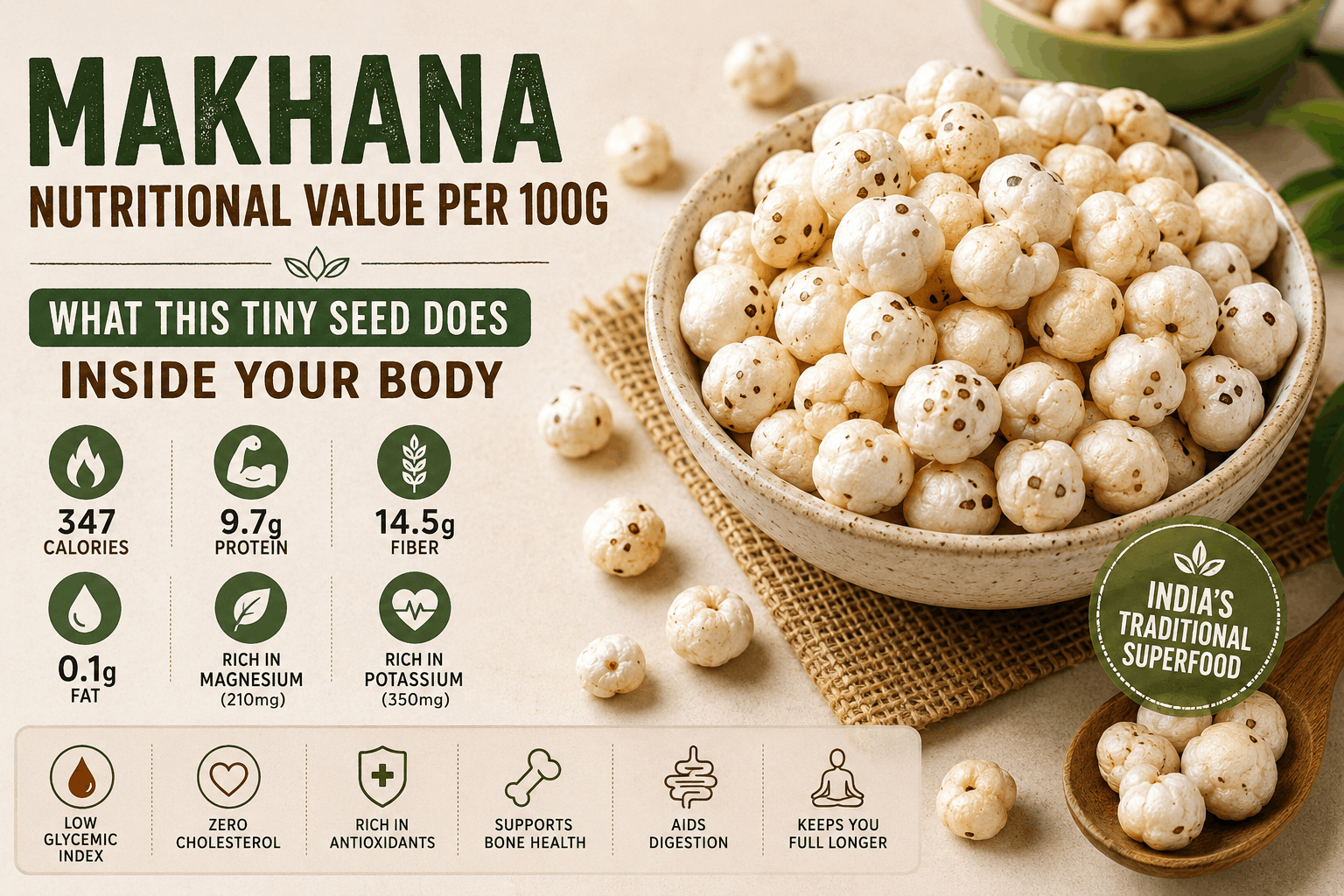
Per 100 grams of plain roasted makhana, with nothing added, you get roughly:
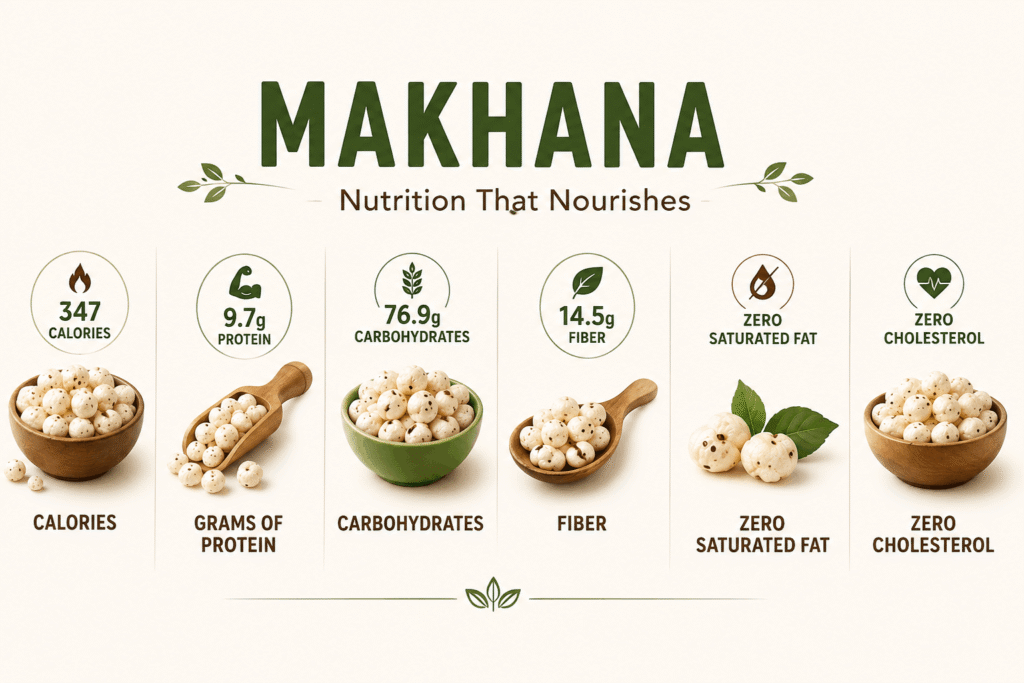
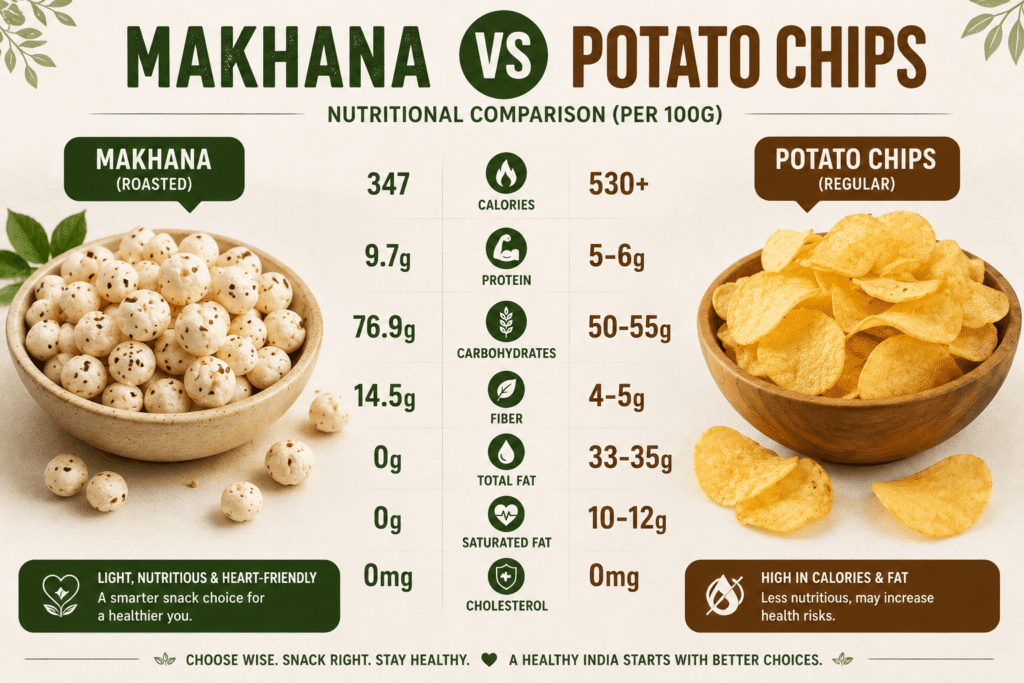
347 calories. That sounds like a lot until you compare it to the alternatives. Potato chips sit at 530+ calories per 100g. Even “light” namkeen runs around 450 to 480. Makhana’s caloric load is genuinely moderate — and more importantly, it earns those calories.
9.7 grams of protein.This one often seems to shock people. Almost 10 g plant based protein per 100 g is quite a bit! Popcorn gives you 3 grams. Puffed rice is at about 2.5 grams. And here’s what’s remarkable; Makhana has all the essential amino acids, including methionine and lysine which are both usually missing or low in the typical Indian vegetarian staples like wheat and rice. It’s worth knowing, considering that Protein deficiency is actually prevalent in India. Makhana Nutritional Value Per 100g
76.9 grams of carbohydrates — but the right kind. Okay, so makhana does contain high amounts of carbs but those are complex carbohydrates and resistant starch, not simple and refined flour. That’s the reason, the glycemic index of makhana is low despite the high carb amount and doesn’t raise the blood glucose levels immediately, unlike an actual meal of maida biscuits and white bread.
14.5 grams of dietary fiber.Likely the most undervalued statistic in the entire profile. The average Indian takes only 15-20 gms of fiber each day, and in urban India with so many processed foods, may be even less. A single 100gm serving of makhana alone more than fulfils half your daily requirement. This fiber sustains good bacteria, digests slowly, keeps cholesterol low and is one of the reasons why a small bowl of makhana at 5 pm really does see you through until dinner . makhana nutritional value per 100g
0.1 grams of fat. Zero saturated fat. Zero cholesterol. These three together are rare in the snack world. Almost absurdly rare. Roasted peanuts have 49 grams of fat. Almonds have 50. Makhana has essentially none — while still being filling and satisfying. Makhana Nutritional Value Per 100g
check another blog: Complete nutrition, health
Minerals: here is where makhana quietly outclasses everything.
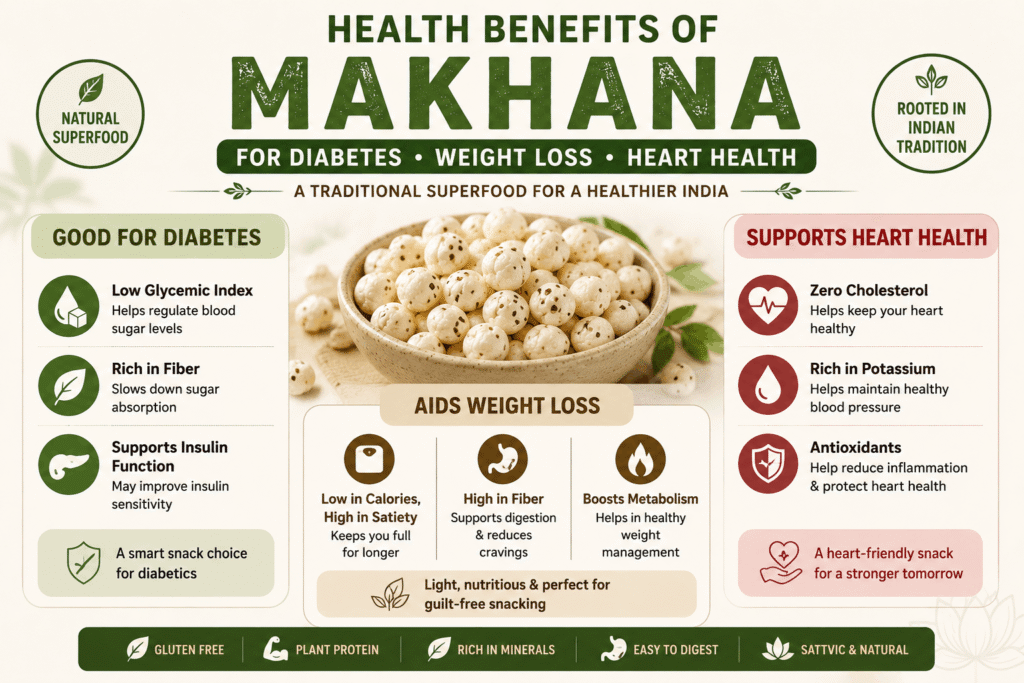
Next we have Magnesium – about 210mg per 100g. There are over 300 bodily processes involving Magnesium; it regulates blood pressure, assists muscle contraction, maintains blood sugar levels and is essential for the production of melatonin which aids sleep.. India has a massive, mostly silent magnesium deficiency problem, especially in urban populations. Anxiety, poor sleep, chronic fatigue, muscle cramps Makhana Nutritional Value Per 100g — many of these daily complaints are directly linked to low magnesium intake. A 60-gram serving of makhana provides nearly 40% of a woman’s daily magnesium requirement. Not a supplement — just a snack.
Potassium stands at 350 mg per 100g, combined with only about 5 mg of natural sodium.But that ratio of potassium to sodium is something. In a country with a diet way overstuffed with sodium from pickles, convenience foods and saltier than a sea dog, food that actually rebalances is significant.
The rest is made up of phosphorus (essential for bone density), iron (needed to make red blood cells) and calcium (bone density).
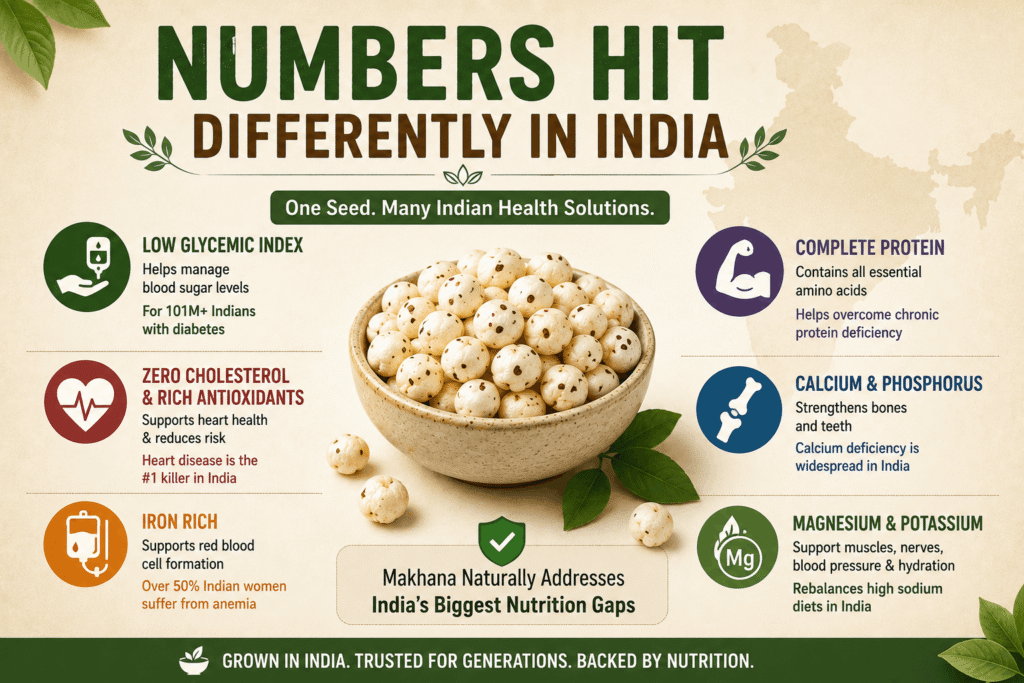
Why These Numbers Hit Differently in India
You can’t read a nutrition profile in isolation. You have to read it against the health problems the person eating that food is actually facing.
India has over 101 million people with diabetes. Cardiovascular disease kills more Indians than any other cause. Iron deficiency anaemia affects over 50% of Indian women. Calcium deficiency is widespread. Protein intake is chronically low across income levels. makhana nutritional value per 100g
Now look at makhana again.
Low glycemic index for the diabetic population. Zero cholesterol and high antioxidants for the heart disease risk. Iron for the anaemia problem. Calcium and phosphorus for bone health. Complete protein for the vegetarians — which is most of us. Makhana Nutritional Value Per 100g
This is not coincidence. Makhana grew in Indian soil, was refined through centuries of use in Indian kitchens and Ayurvedic practice, and happens to address the exact nutritional gaps most Indians carry. You don’t need to import your health solutions. This one was already here.
Check another blog: How Nutrition Works
The Antioxidant Side Most People Never Hear About
In addition tomacrosandminerals, makhana contains various other compounds that possess interesting properties and have gathered researchers’ attention over the last few years.
Gallic acid: This compound has shown a significant role in preventing damage to cells and reducing inflammation by inhibition of the signalling pathways responsible for chronic inflammation. Kaempferol: A flavonoid present in makhana, which has shown in studies to block NF-kB signaling pathway which a signaling switch that contributes to joint problems to heart disease. Chlorogenic acid: slows glucose absorption, therefore helping with the management of blood sugar levels outside the effects that fiber alone can produce.
A 2023 study on germinated makhana showed a significant improvement in blood sugar control and activity of antioxidant enzymes on diabetic model animals. In an earlier study with animals, a compound named 2-hydroxybetulinic acid in makhana seeds has proved to reduce insulin levels and simultaneously preserve pancreatic, liver and kidney tissues.
None of this makes makhana a medicine. But it does make it an unusually functional food.
Roasting vs Frying — A Difference That Completely Changes the Numbers
Here’s something most makhana content glosses over entirely. The nutritional profile above applies to dry-roasted makhana. The moment you deep fry it, that near-zero fat content climbs sharply. The moment you toss it in excessive ghee, the calorie count jumps. A packet of butter-and-cheese flavoured makhana at 430 calories per 100g is nutritionally a completely different product from plain roasted makhana at 347.
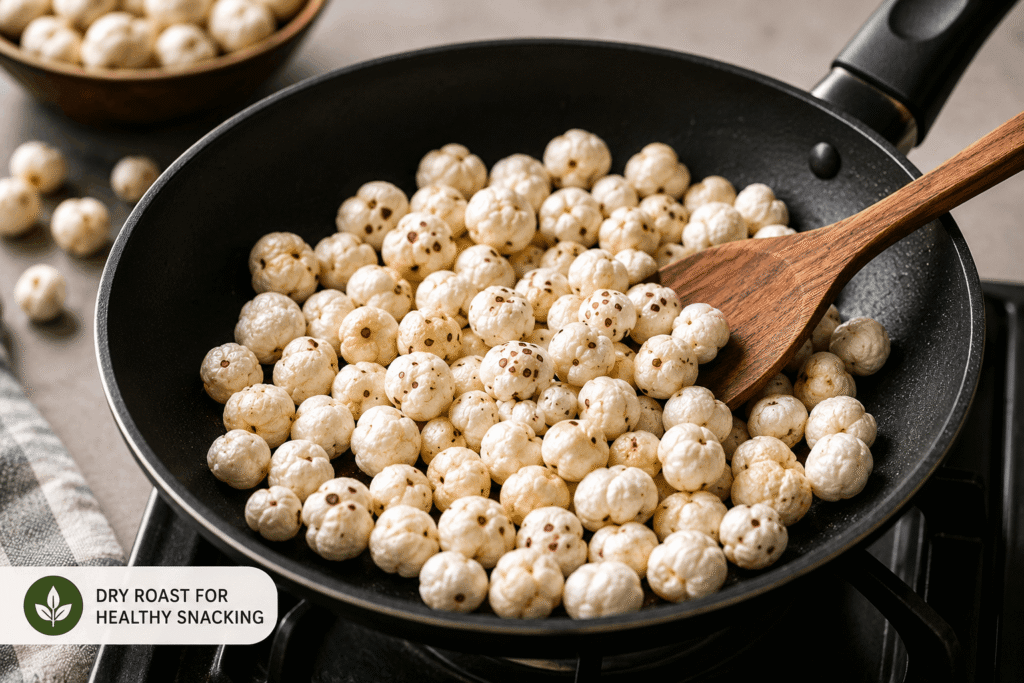
The preparation is part of the nutrition. Dry roast on low flame for 5 to 7 minutes, add turmeric, black pepper, and a very small pinch of sendha namak if you like. That version preserves everything good about makhana. The heavily flavoured, oil-coated version is essentially a premium snack, not a health food — regardless of how it’s marketed.
How Much Should You Actually Eat Per Day
The reasonable portion to eat on a day is between 20 and 30 grams. It’s approximately equal to 1 medium katori. If it’s eaten at the 30 g serving size it amounts to about 104 calories, about 3 g of protein and 4.3 g fiber. It’s a decent contribution to a single snack in between meals. When used as an ingredient like in kheer, kadhi or makhana sabzi the portion naturally will adjust according to the food being cooked.
There is no upper limit for healthy adults, however if the portions consumed on a day are beyond 60-70 g in a fiber-depleted diet it will lead to a bit of bloatiness. Don’t start eating it daily from the beginning if you are not accustomed to it.
The potassium content should be mentioned if one is on diuretics or blood pressure medicine. It does not cause harm, it is just that it does compete with some drug mechanisms. Pregnant women suffering from gestational diabetes should check its contribution to carbohydrates along with other foods.
Why Fasting Food Became Fitness Food
The original function of makhana in Indian culture was that of a fasting food for navratri, Ekadashi and Mahashivratri. It was allowed during fast days not arbitrarily on the pretext of a religious order, but it truly helped in fulfilling a bodily need during food deprivation- Makhana Nutritional Value Per 100g stable energy by slow digesting carbs, replacing minerals by virtue of its unique magnesium & potassium content, highly easily digestible and so no stress on digestive system.
The same properties that made it ideal for fasting now make it ideal for modern fitness contexts. Pre-workout, post-workout, between meetings, before a long commute — makhana works in all those situations for the same underlying reasons it always did. The body’s needs haven’t changed. The context has.
The Bottom Line
Makhana is not faddish, it is a seed that has been grown, roasted and consumed in India for thousands of years. With an astonishing nutrition profile: 347 calories, 9.7g protein, 14.5g fiber, negligibly little fat, phenomenal magnesium, robust potassium, complete amino acids and abundant antioxidants it is truly one of the most complete foods on the planet, regardless of price.
Never was a dabba on Mom’s 3rd shelf wrong – it simply had no label.

 Admin
Admin
[…] Makhana Nutritional Value Per 100g […]
[…] ghee and rock salt and you have a crisp, delicious snack instead of fried stuff. If you check the Makhana Nutritional Value Per 100g, you’ll notice it’s packed with magnesium, calcium, and protein while being relatively […]
[…] am also a little upset that Ragi–which really is one of the most nutritious grains on the planet-doesn’t receive much publicity outside Karnataka. Ragi (finger millet) is a […]
[…] Check another blog: Makhana Nutritional Value […]
[…] Check another blog: Makhana Nutritional Value […]