 Admin
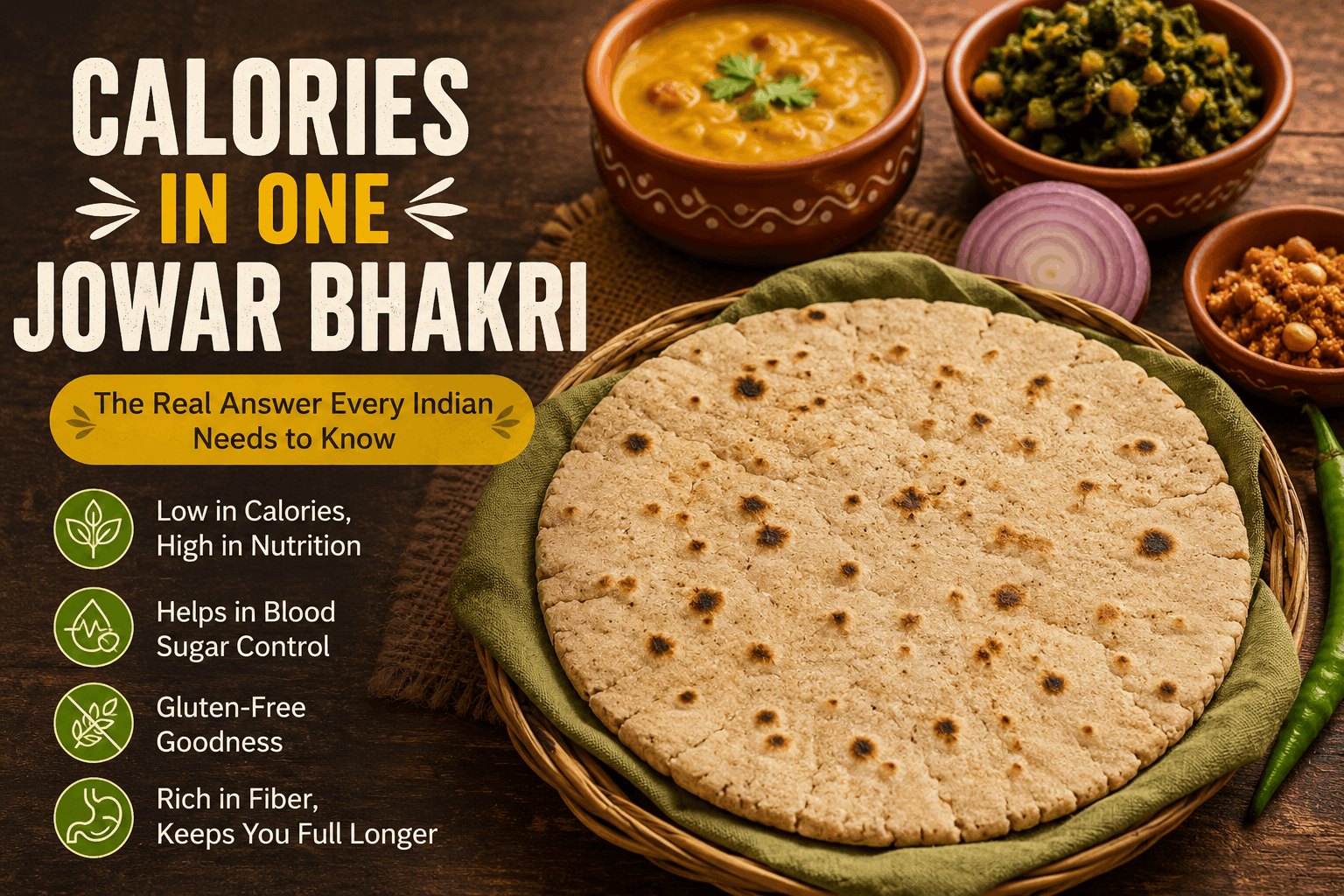
Admin Calories in one jowar bhakri is something every health conscious Indian should know — and yet most of us never bother to find out. My mother certainly never counted them. Every morning she would pat two thick jowar bhakris on the tawa, serve them with leftover dal and a raw onion, and that was breakfast. No apps. No nutrition labels. No stress. She was also the healthiest person I knew.
First — What Exactly Is Jowar Bhakri?
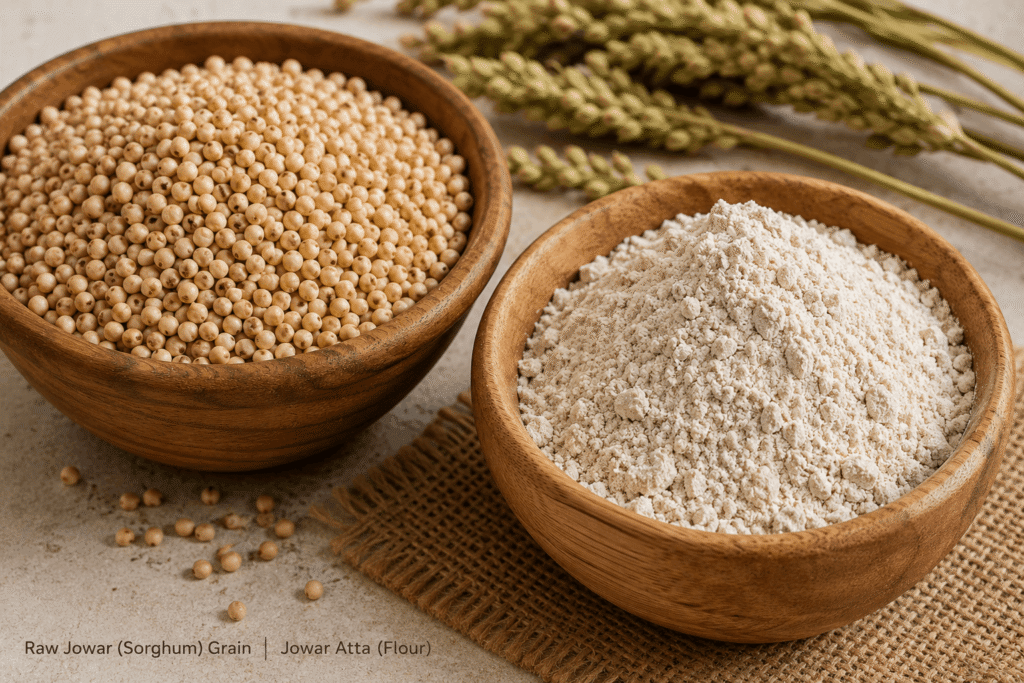
Jowar translates to sorghum. And sorghum is a grain that has been grown for centuries on the Deccan plateau. In Maharashtra it is known as jowar, in Karnataka as jola, in Andhra as jonna, and in Tamil Nadu as cholam.
A bhakri, made of jowar flour, is thick, somewhat rough and very mildly earthy. It requires no oil in its cooking; it is merely patted by hand and cooked first on a dry tawa, then sometimes directly on the flame. The finished article is a flatbread that is rustic, satisfying and truly healthy.
Now to what you’re really here for.
Check another blog: Makhana Nutritional Value
So How Many Calories Are Actually in One Jowar Bhakri?
So, the simple answer to that is.
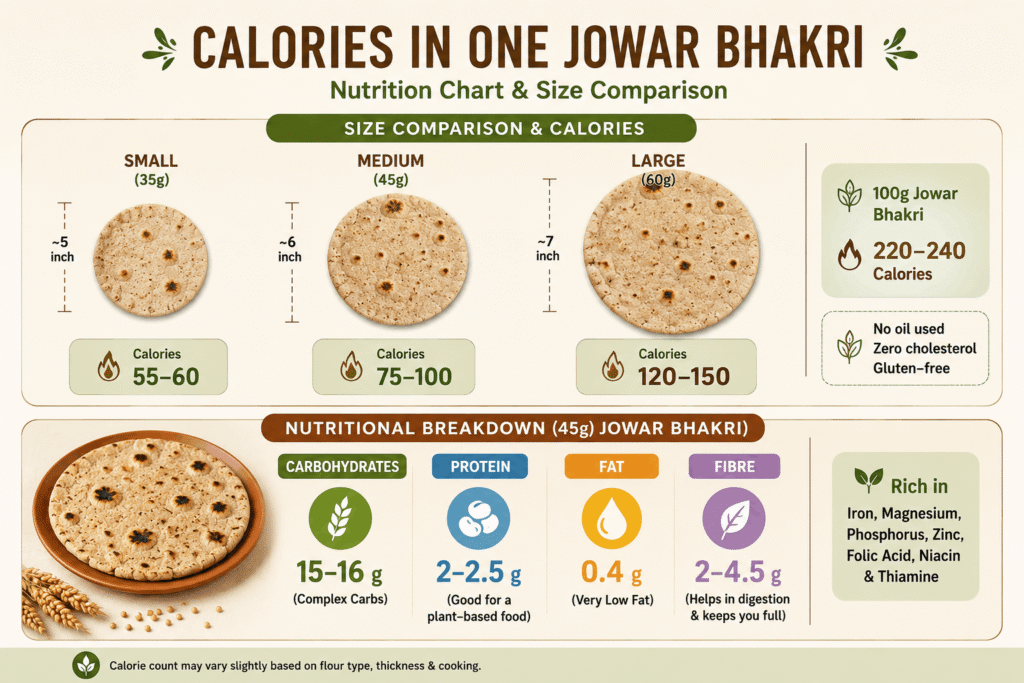
An average jowar bhakri ( the type usually made in homes throughout India; approximately 6 inches in diameter and about 45g in weight) contains about 75 calories.
That is it. Seventy five calories. No oil. No refined flour. No additives.
But here is what most calorie articles fail to mention. The bhakri your mother makes at home is probably not 45 grams. It is likely bigger.On an average, in a Maharashtrian or Karnataka household a homemade bhakri weighs close to 50-60 grams. This will weigh approximately between 100-150 calories. Instead of a vague one number, which can leave you guessing, here is an actual size range with calories; calories in one jowar bhakri
Small bhakri- 35 gm will give approximately 55-60 calories.
Medium average bhakri- 45 gm will give approximately 75 calories.
Large homemade bhakri- 50-60 gm will give approximately 110-150 calories.
A 100 grams cooked Jowar bhakri can contain approximately 220-240 calories.
A simple fool proof method for doing this at home would be weighing it just once. Once done, forever you would be able to make a good guess of what you eat. Calories in One Jowar Bhakri: The Real Answer Every Indian Needs to Know
Check another blog: Diet Dry Pepper
What Is Actually Inside That One Bhakri?
Calories are just one number. The real question is what those calories are made of.
This is what constitutes a simple 45 gram jowar bhakri:
The carbohydrate figure is between 15 to 16 grams. They are complex carbohydrates and not simple refined sugar that will trigger blood sugar level spike. It’s slow releasing carbs.
The protein count comes to between 2 and 2.5 grams. While not a huge number, it is an impressive one for a grain and water flatbread.
Fat is almost negligible — around 0.4 grams. Because there is no oil used in making a traditional bhakri.
Dietary fibre ranges from 2 to 4.5 grams depending on the size and how the flour was milled. This fibre is one of the most important things about jowar bhakri and we will come back to it.
Cholesterol is zero.
And the micronutrients. Iron, magnesium, phosphorus, zinc, folic acid, niacin and thiamine. Individually the quantities present in one bhakri are not substantial, but consumed day after day over weeks and months contribute a real boost to your system.
Check another blog: Moringa 1 Teaspoon Powder
The Blood Sugar Question — Really Important for Indian Families
India has a massive number of people diagnosed with type 2 diabetes. And if it isn’t you personally it’s definitely somebody in your family or your neighbourhood.
This is where the significance of jowar bhakri lies.
Every food we eat has something known as a GI which basically denotes the speed at which food raises blood glucose levels
. High glycemic index foods cause fast sharp spikes. Low glycemic index foods cause slow steady rises.
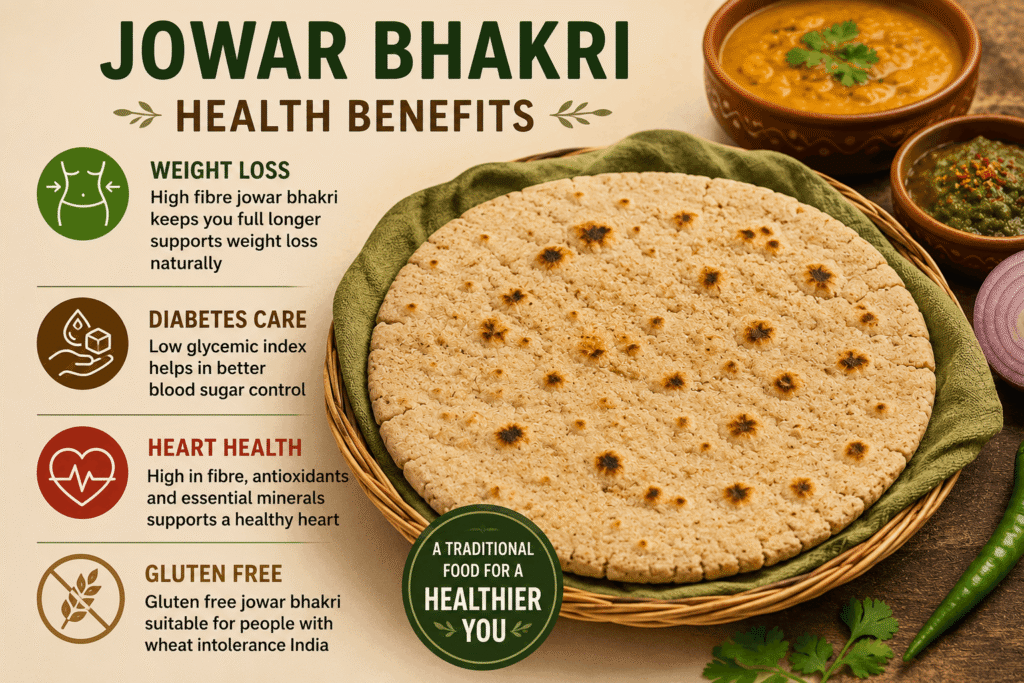
White rice has a glycemic index of around 70 or above. Regular wheat chapati is not far behind. On this scale, jowar bhakri can be any number between 45 and 68, depending on how it is cooked and which variety of flour is used. So in terms of value, it falls comfortably in the low to medium range. calories in one jowar bhakri
So what does this mean for the regular person like us? When we eat jowar bhakri as opposed to say, white rice, or plain wheat chapati, our blood sugar levels do not shoot up and then crash. It gradually climbs, stays put and comes down equally gradually. Your body is being provided with a constant supply of energy instead of a brief rush followed by an equally brief drain.
This is not a minor benefit when trying to control, or prevent diabetes. This is basically the difference between a food that complements the needs of our body, and one which actively works against them.
Check another blog: The 30-Day Indian Diet Plan for Acne
Why Jowar Bhakri Keeps You Full for So Long
Ever had a bowl of white rice and been hungry again in 2 hours? Had two jowar bhakris instead and felt full till your next meal?
That is fiber doing its job.
Dietary fiber is very rich in jowar. Fibre helps to slow down the movement of food in your digestive tract. When food movement is slow, you remain fuller for a longer time. When you remain fuller for a longer time, you consume less food and do not have to fight with yourself to be hungry.
This is the most natural form of appetite control there is. No supplements. No meal replacement shakes. It’s simply fibre from an old, ancient cereal eaten by farmers for millennia. calories in one jowar bhakri
It’s truly helpful stuff for anyone aiming to lose weight while being sensible and not eating like a ‘starver’.
Jowar Bhakri vs Wheat Chapati — The Comparison Everyone Asks About
This is a question that I get asked almost every day. And frankly the answer is that both foods are healthy. However, one isn’t better than the other depending on what you are trying to achieve.
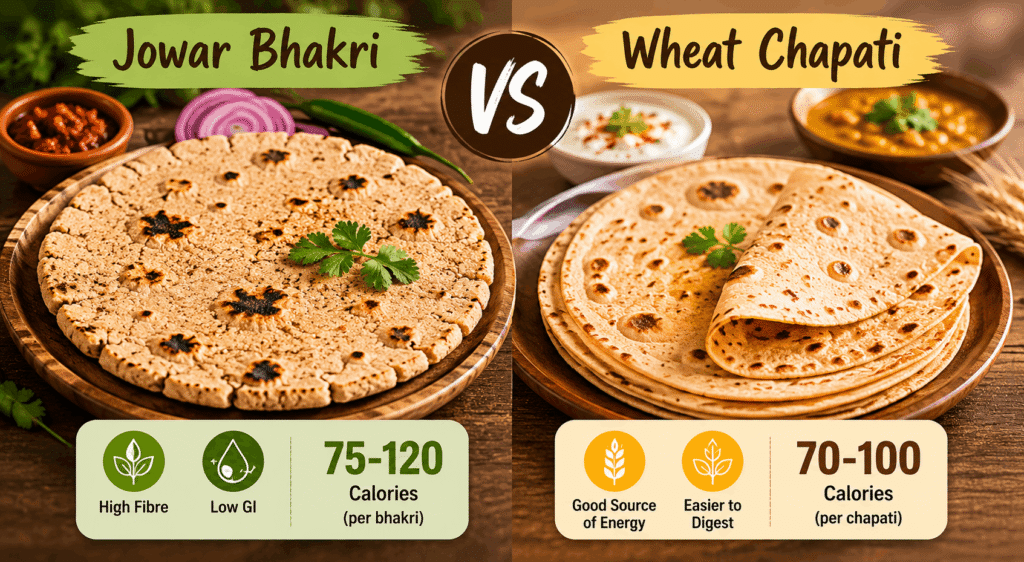
Jowar bhakri is higher in fiber than wheat chapati. Lower GI (glycaemic index). Gluten free and therefore is suitable for those allergic or intolerant to wheat. Cooked without oil. Higher in antioxidants than white wheat.
Wheat chapati on the other hand is easier to chew and cook. It goes with virtually anything. And by no means unhealthy!
For a healthy active person with no specific health concerns, chapati is perfectly fine daily food.
But if you are managing your weight, watching your blood sugar, dealing with digestive issues, or trying to avoid gluten — jowar bhakri has a clear edge.Just changing one meal of the day from wheat chapati to jowar bhakri, which is a very simple change, can bring about remarkable changes in the body. calories in one jowar bhakri
What to Eat With Your Jowar Bhakri
This is where people make mistakes. They pair the jowar bhakri with calorie rich, heavy gravies and blame that they are unable to shed any weight.
The conventional pairing is conventional because they are suitable nutritionally, not just traditionally. Plain toor or moong dal with jowar bhakri ensures you consume a meal with decent protein, fibre and complex carbs that provide slow energy release. It is not only palatable and filling, but also nutritionally balanced. Any basic vegetable sabji like lauki, bhindi, methi or the vegetable that is in season provides ample vitamins at minimal calorie cost. Lastly, curd or lassi helps the meal remain calcium rich and pro-biotic with its consumption, not to mention its cooling effect in Indian summers. calories in one jowar bhakri
Peanut chutney is the traditional Maharashtrian companion to bhakri for a reason. Peanuts add healthy fats and protein that slow digestion even further.
What you need to be careful about is extra ghee. A small amount of ghee on a bhakri is customary and is not detrimental. Pouring a lot of ghee over every single bhakri can really amp up the calories quickly! One teaspoon of ghee is equivalent to about 45 calories!
How Many Bhakris Per Day Makes Sense?
It really depends on you, and on your size, level of activity and health goals. However, here are some useful points of reference.
For weight loss, two medium bhakris per meal eaten twice a day is a reasonable approach. Served along with Dal and Sabzi, it makes a good, wholesome meal without too many calories.
A good guide for weight maintenance for an average moderately active adult would be to have 2-3 bhakris per meal.
For diabetic patients, 2 bhakris per meal with protein and non starchy vegetables is normally suggested – but check with your doctor or dietitian for your personal diet plan.
For children, have 1-2 small bhakris depending on age and appetite.
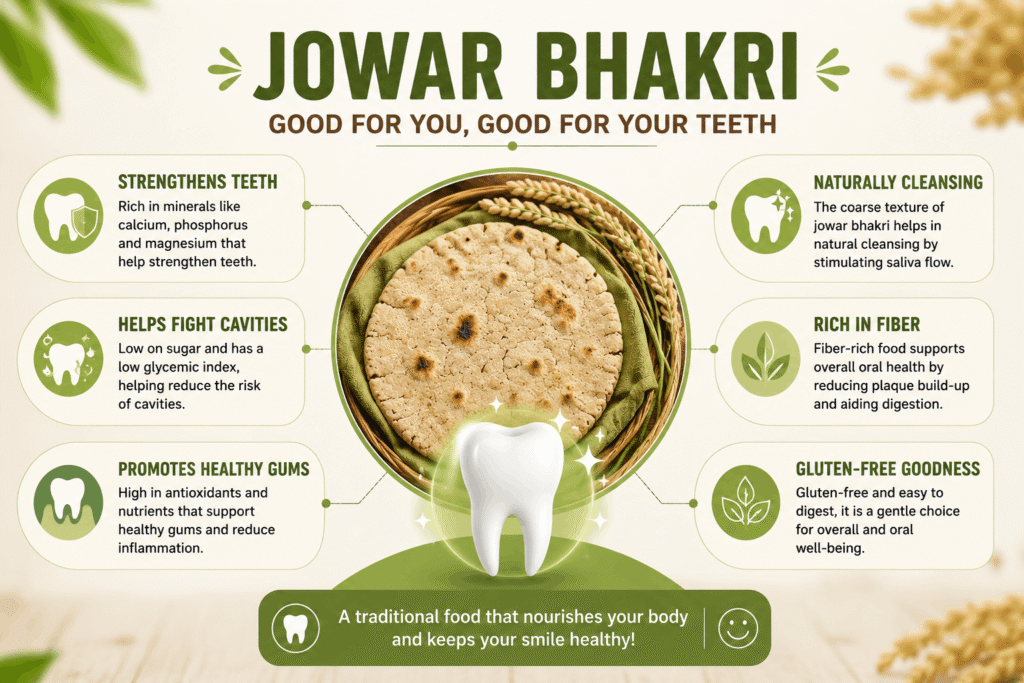
Three Things People Get Wrong About Jowar Bhakri
First misinformation, jowar bhakri increases weight, WRONG. It is low in calories and rich in fibre. Over-intake of calories is responsible for weight gain. Not the jowar bhakri.
Second misinformation, do not eat bhakri at night, WRONG again. Fiber-rich food helps in overnight digestion. Provided your total calorie intake throughout the day has been monitored, eating jowar bhakri for dinner would not harm you. calories in one jowar bhakri
Third misinformation, jowar bhakri is old or inconvenient, WRONG. Mumbai’s health cafés are serving it in the form of thali. Dietitians in Pune and Bengaluru are giving its prescription. Mumbai’s thirdies are making it mainstream. It is a vintage food but currently, its presence has become very strong. calories in one jowar bhakri
The Bottom Line
A single jowar bhakri will range from 75-120 calories, depending on the size of the bhakri. It provides you with fiber, complex carbohydrates, protein (in a small amount), some micro-nutrients, and has a low glycemic index. It has no oil added, is naturally gluten-free, and contains zero cholesterol.
In the case of those chronic lifestyle diseases that are silently turning into a crisis, with every Indian kitchen- diabetes, obesity, heart diseases and digestion- related illnesses- jowar bhakri truly has to be one of the most health protective everyday foods in India. And it was always there at the Indian kitchen table. calories in one jowar bhakri
Your grandmother didn’t need a diet plan; she just made bhakri.
Perhaps it’s time you brought bhakri to your plate.
If you have a specific medical condition like diabetes, heart disease, or any chronic illness, please speak with a registered dietitian before making significant changes to your daily diet.

 Admin
Admin
[…] a glass of plain water first. Room temperature, nothing fancy. If you like warm water with lemon, or soaked methi water — fine, that’s a nice old-school habit, but don’t […]
[…] Amla murabba will come in handy when fresh amla is not in season wherever you might be. One piece each morning on an empty stomach with a glass of hot water – it’s a recipe passed down through Indian households and the only reason it endured is, well, it’s effective. […]
[…] the “liquid calories” stealthily and without fuss. Two glasses of sweet chai a day, one glass of cola, and one packet of […]
[…] 15 minute workout at home solves all of this quietly. No membership. No commute. No questions. Just close the bedroom door, roll […]
[…] also increase the fibre and the bulk of your poha and make it quite filling without adding too many calories by adding lots of vegetables, like green peas, carrot, onion or even grated cauliflower. Use a teaspoon of oil at most for the […]
[…] Check another blog: Calories in One Jowar Bhakri […]
[…] Check anther blog: Calories in One Jowar Bhakri […]